Agent Standup Band
Your Claude Code, Codex and Mistral Vibe sessions as a live, animated team call: who is working, who waits on whom, who needs you. VS Code extension, terminal command, desktop app. Runs locally, zero tokens.
claude plugin validate to auditGuide →Writes files, executes local shell processes, or programmatically drives Claude.
Statically scanned from hooks & source. Learn how to audit
Agent Standup
See which of your agents is working, stuck, waiting on another one, or burning tokens — across all your Claude Code, Codex, Mistral Vibe and Cowork sessions, at zero token cost. Agent Standup turns the session files Claude Code, Codex and Mistral Vibe already write into a live team call (and a board of every session): it only reads local files and never calls Claude unless the call is held in French, Spanish or Brazilian Portuguese, or you turn on the jokes.



No editor? Try it in 30 seconds from any terminal (Node 18+), then ⚙ → Source → Demo if you have no session yet:
npx @double_geste/agent-standup@latest --open
Your Claude Code, Codex or Mistral Vibe session as a live team call. The lead gives orders, sub-agents join the call, work at their desks, share their screen and report back — with voices, expressions and a view of the real work as it happens.
Works with: Claude Code · Codex · Mistral Vibe · Cowork — in VS Code, Cursor, Windsurf, any terminal, or as a desktop app.
Just installed the extension? Click the Agent Standup icon in the Activity Bar (or run Agent Standup: Open live call): the call starts at once, silent, and your first click in it turns the sound on. No session yet: press ▶ Watch the demo.
→ Website & download: https://agent-standup.com
🌐 Français · 繁體中文 · 简体中文 · Español · Deutsch · Dansk · Português · 日本語 · 한국어
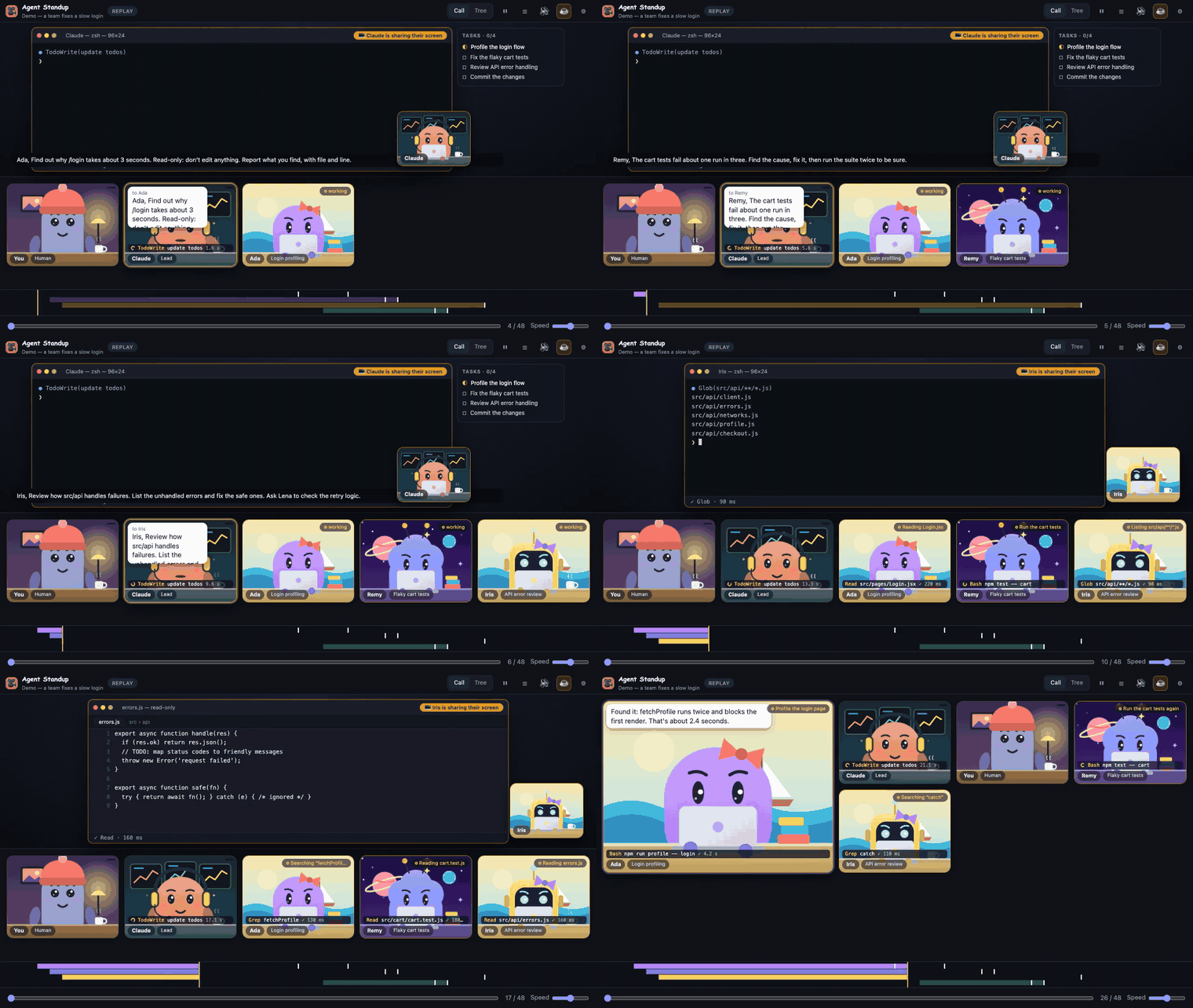
A fictional team fixing a slow login page — the built-in demo (⚙ → Source → Demo). Watch the full 1-minute video.
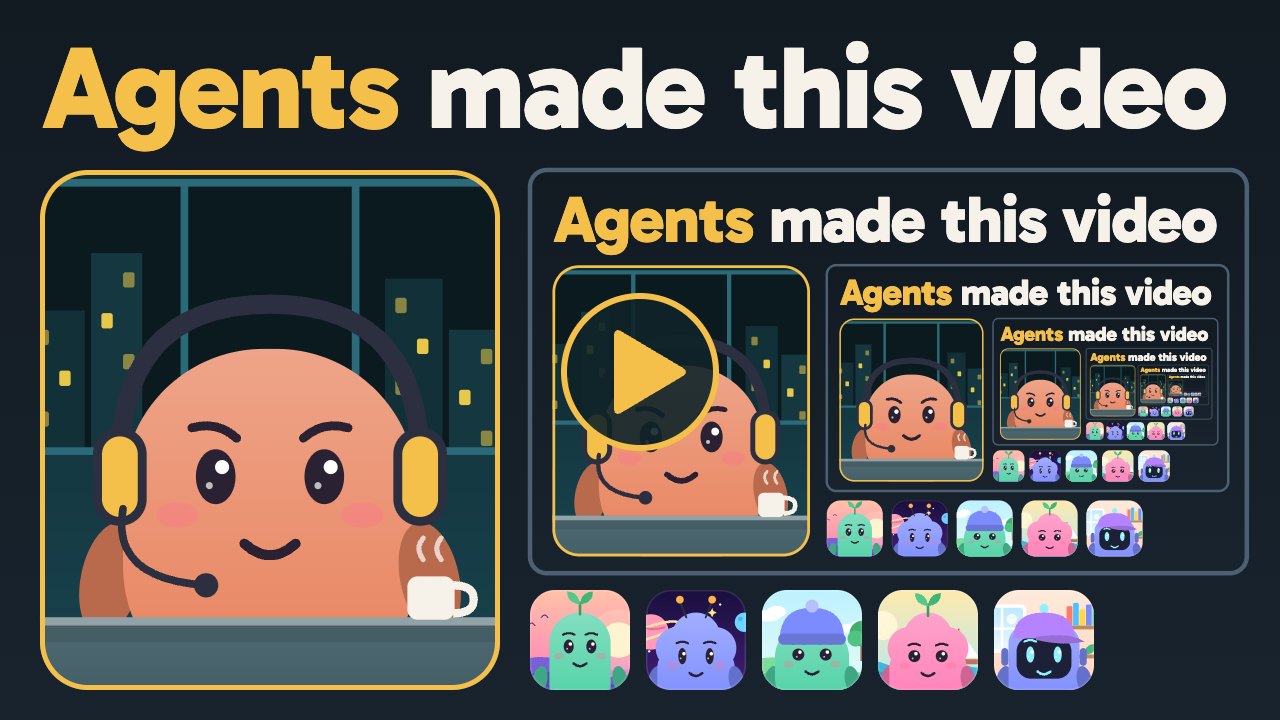
New: Agent Standup is on YouTube. The first video is the very session that made it, replayed in the app with its own voices (2 min 51). Subscribe to the channel.
Halloween pack (optional)

Eight characters drawn by hand by Fabien Coupas, each in its own room: a pumpkin leads the call, you are a vampire, and a ghost, a cat, a bat, a wolf, a witch and a crowd of skeletons do the work.
It is entirely optional. Agent Standup is and stays free and MIT licensed, and nothing in it is locked behind the pack: every feature and the default characters stay as they are, and the vampire is free for everyone. Buying the pack (2 €, or more if you like) is simply a way to support the artist who drew it and the developer who makes the app; the money is shared between them.
See the pack, or in the app: ⚙ → Characters → Halloween pack. The pack's pictures are not part of the open-source code: they remain the artist's work.

Unofficial community project, not affiliated with or endorsed by Anthropic, OpenAI or Mistral AI. "Claude" is a trademark of Anthropic; "Codex" is a trademark of OpenAI; "Mistral" is a trademark of Mistral AI.
What you get
- Token usage per agent — a ⚡ counter in the header, on each tile, on each line of the agents list and in the camera of the agent who shares its screen shows how many tokens each agent used (input + output + cache writes; cache reads shown separately in the tooltip), counted once per message as recorded by Claude Code. Handy to see which sub-agent is the expensive one. When a session mixes models, each count says which model spent it (“⚡ 391 · Haiku”). It is read from the session files, not an estimate of your bill.
- Stuck or quiet agents — in the live call, a tile pulses amber with ⏳ when a command has been running for over a minute, shows 💤 when a working agent has gone quiet for 3 minutes, a red ✗ counter for failed tool calls, and a ♻ count of repeated work (a file read again with no change, the same search twice, a failing command run again). Hover any of these badges (or tap it) to see the calls behind it. The browser tab title shows how many agents are working.
- Built-in demo — no session yet? ⚙ → Source → Demo plays a fictional team (no data of yours).
- Live call — follows your newest session (Claude Code, Codex or Mistral Vibe) in real time. Each agent is a small character at its desk; the one who speaks gets the spotlight and keeps it until someone else talks. Agents never talk over each other: when several have something to say at once, they take turns, so every line is heard.
- Real voices, lip-sync — lines are spoken aloud by a small speech model on your machine (a one-time install); mouths follow the actual volume of the voice. Until then, and if you prefer it, the agents babble (see Voices).
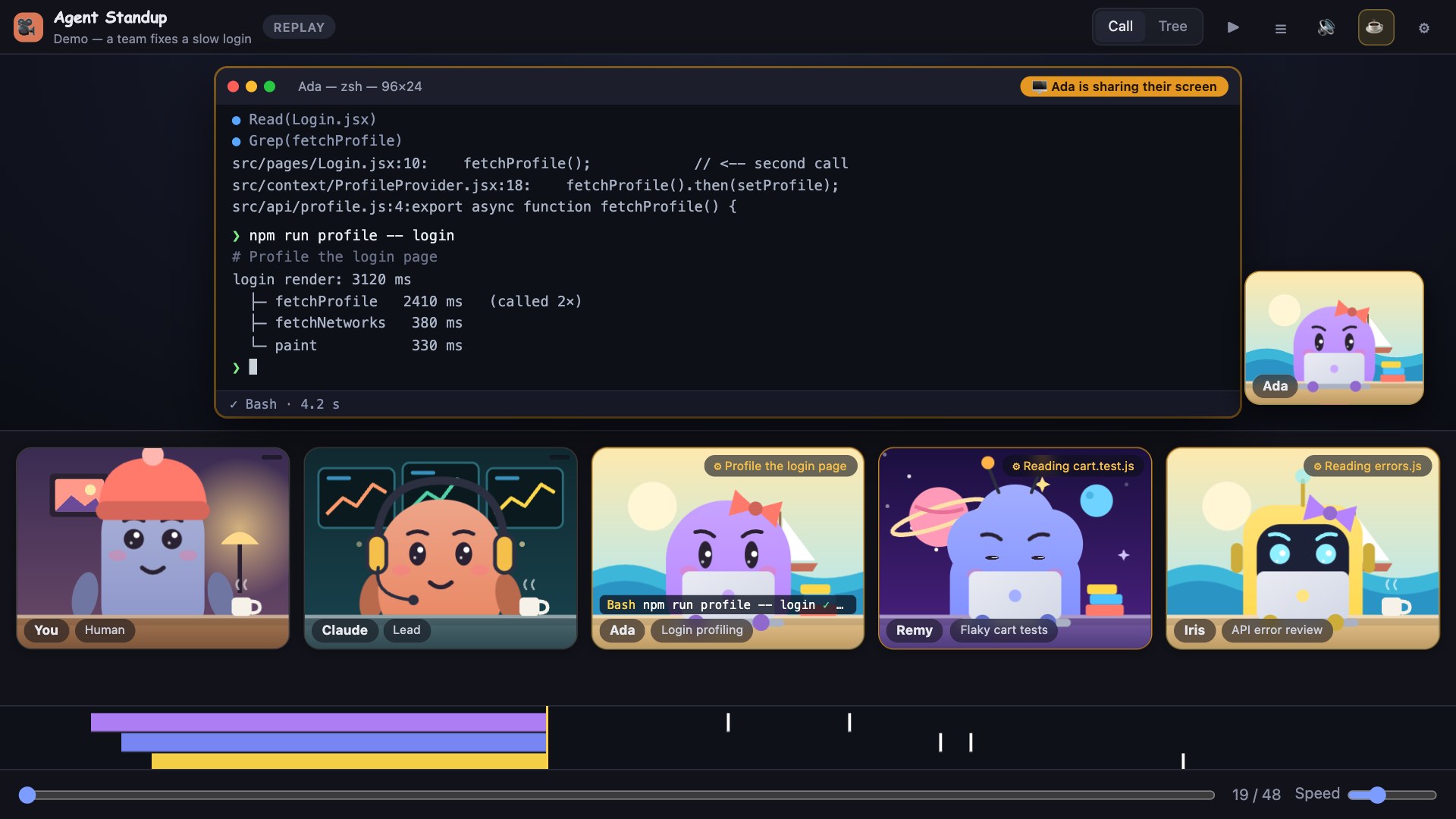
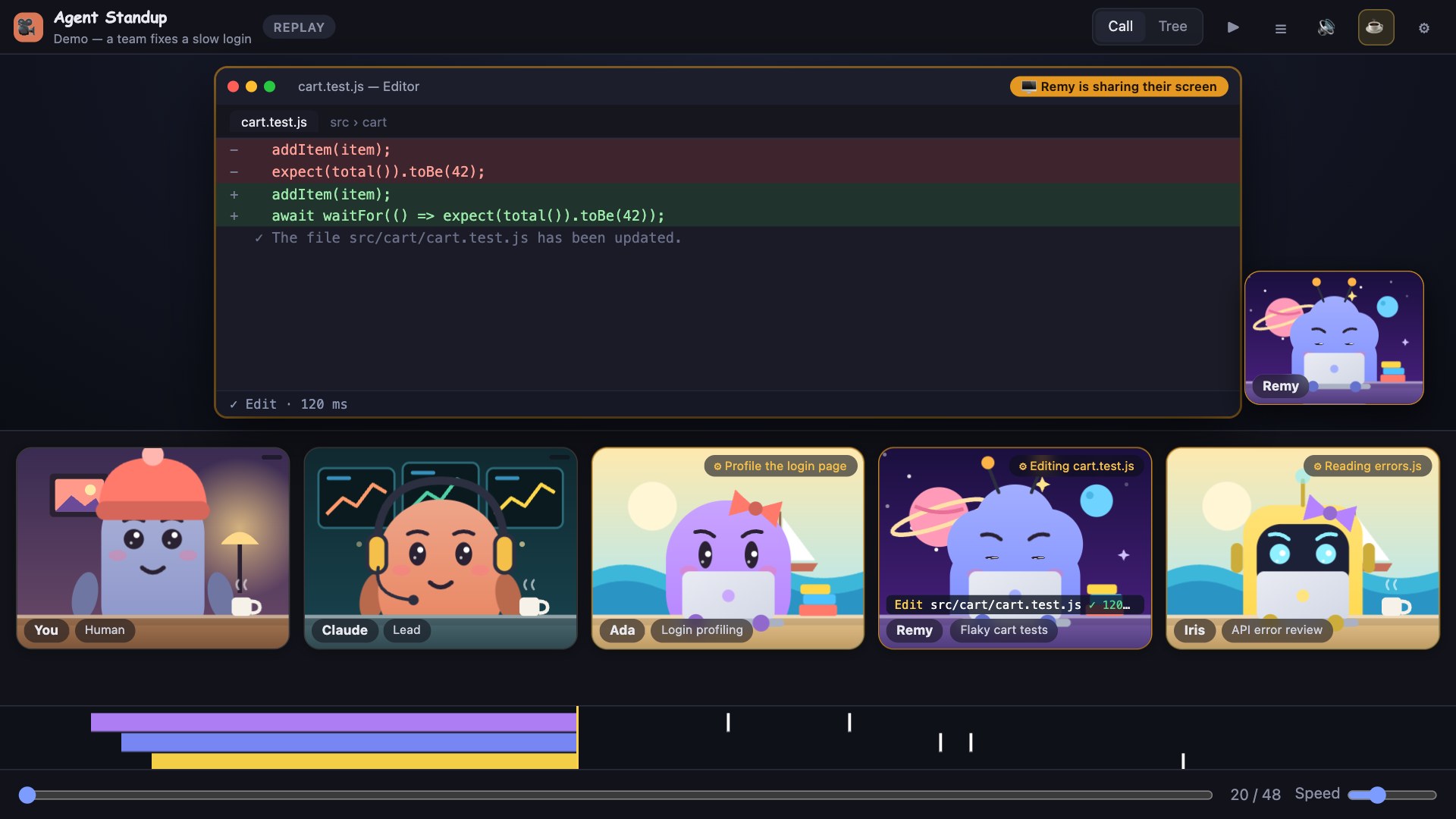
- Live screen sharing with the real output — when an agent works, its screen fills the stage (presenter's camera in the corner, "sharing" badge): a terminal with the command history and the actual output of each command, search results and tool calls; or an editor with the file it reads (real content and line numbers) or the exact diff it applies. See What you see for each agent below.
- Agents come and go — a sub-agent joins when it is given a task and leaves the call 2 minutes (playback time) after its report, with a dissolve animation. It comes back if it gets a new task.
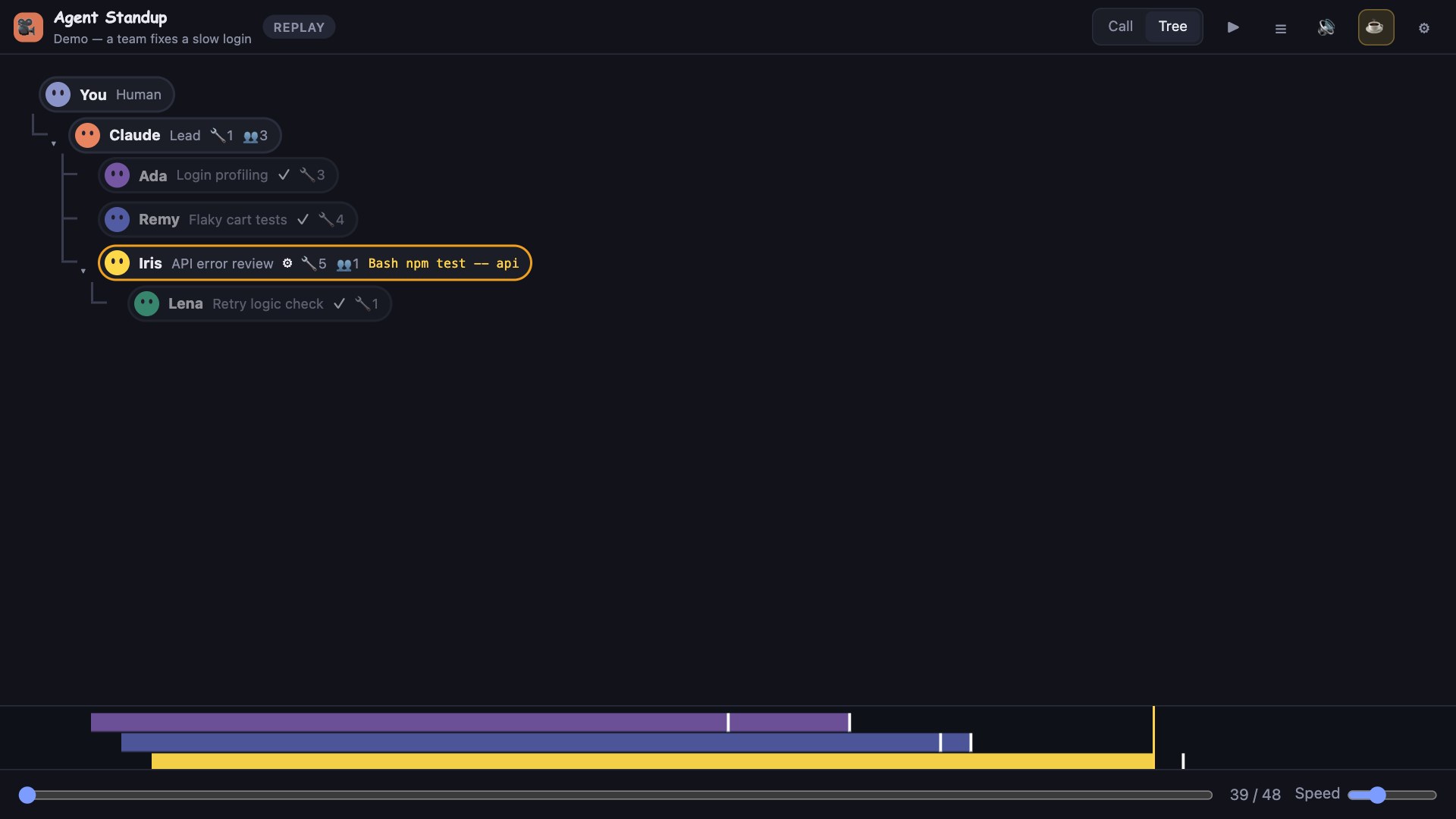
- Sub-agent tree — the full hierarchy (you → the lead → sub-agents → their sub-agents) with status, tool counts and the current action.
- Click any agent — its prompt, tool usage and reports.
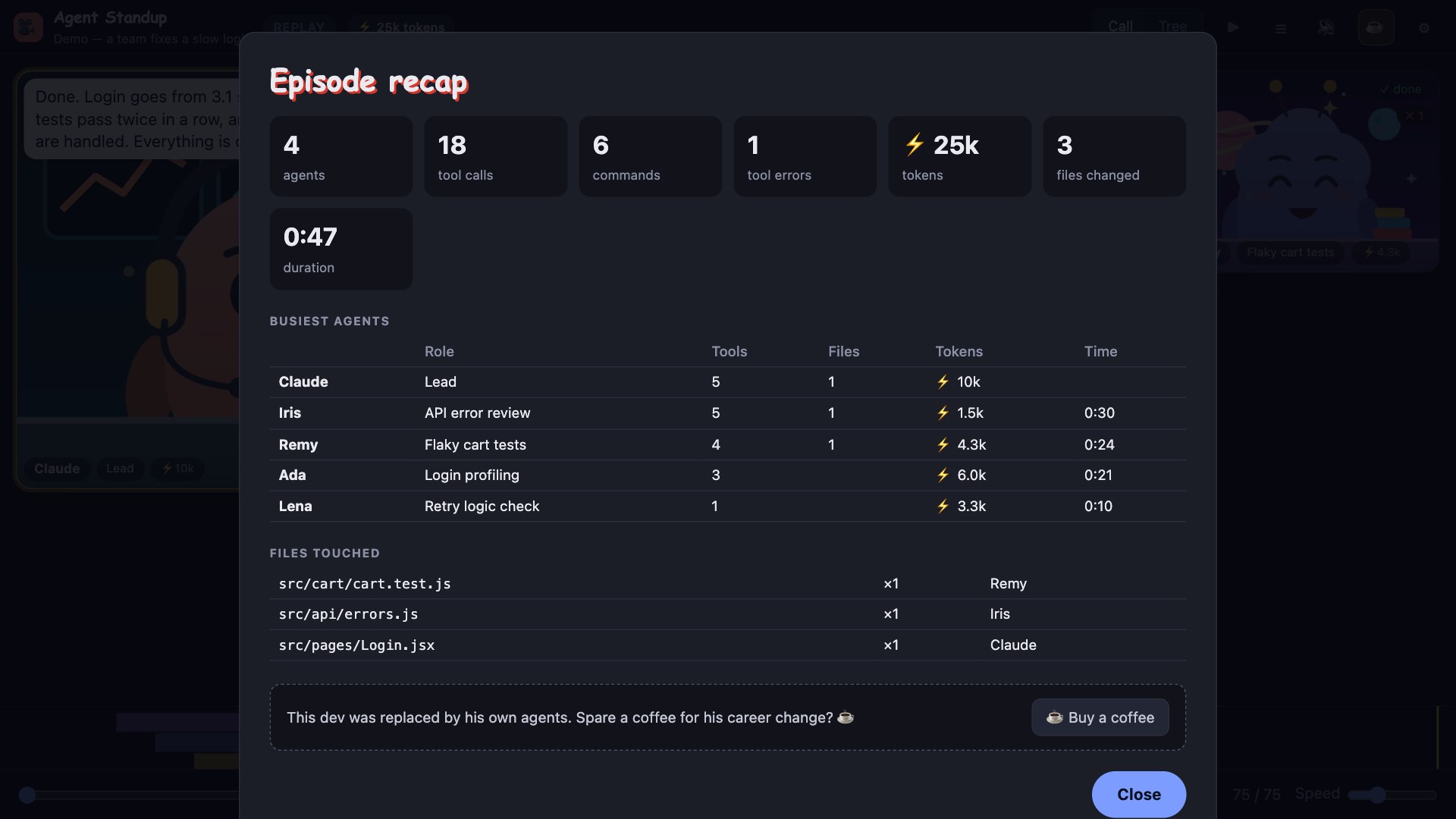
- Replay — pick any past session, scrub through it, see a timeline of who worked when, and get a recap (agents, tool calls, commands, files changed, busiest agents).
- Video export — ⚙ → Tools → 🎞 Export video records the call at 1280×720 with voices and subtitles, as an MP4 (H.264 + AAC) when the browser can record it, and as a
.webmwhen it cannot. X, phones and most chat apps refuse.webm. - Clip to share — ⚙ → Tools → 🎬 Clip to share (25 s) records about 25 seconds, saved as
agent-standup-clip.mp4(.webmwhen the browser cannot record MP4). In the middle of a replay it starts at the current position; otherwise one spoken line before the first error or loop of the session, and failing that at the moment the lead first hands out work. The line being said when time is up is finished rather than cut, so the length varies by a few seconds. The clip carries the site address (atoll92.github.io/agent-standup) in the top right corner and ends with a short end card; the full export has neither. - Hide code & file names in videos — ⚙ → Tools, off by default, for the full export and the clip. Commands, their output, file contents, diffs and search results on the shared screen are drawn as grey bars of the same length; file names are removed from the window title and from the activity tags on tiles (the tool's name, e.g.
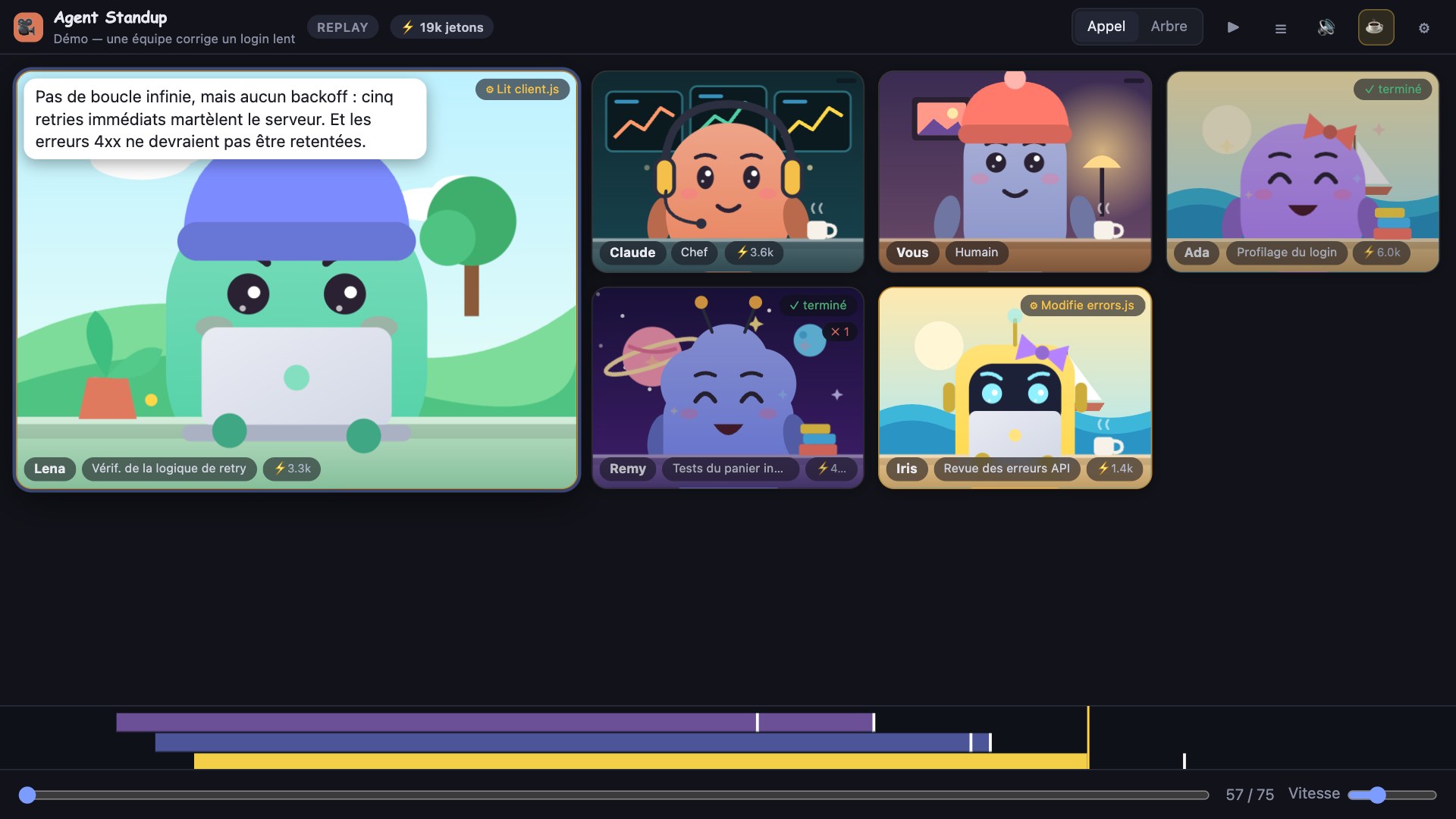
BashorRead, stays); the session title is replaced by "Agent Standup"; pictures (screenshots, images) become an empty frame. What the agents say is not masked: speech bubbles, subtitles and voices are kept as they are, so check the clip before posting if agents quote code or names aloud. - In eight other languages — the call can be held in French, Spanish, Brazilian Portuguese, German, Danish, Japanese, Korean or Chinese (Simplified or Traditional): agent text is translated on the fly and read by natural voices of that language (see below).
- Office music — optional live web radio (FIP and its themed stations) that fades down smoothly while an agent talks and fades back up when the room goes quiet.
- Office ambience, optional (off by default) and fully synthesised: keyboards that type when agents run commands, clicks when they read, a coffee machine, a phone buzzing, a far-away door… (⚙ → All settings → Office ambience). Plus small reactions and jokes between agents ("episode mode").
Claude Code plugin
You can also open the call from inside Claude Code. The plugin adds two skills: /agent-standup:open starts the app and opens the call in your browser, and /agent-standup:status says in one line who is working and who needs you.
/plugin install agent-standup --marketplace Atoll92/agent-standup
On Claude Code before 2.1.275: /plugin marketplace add Atoll92/agent-standup, then /plugin install agent-standup@double-geste. The plugin runs the same npm package as the command line, pinned to an exact version.
A line above your prompt. A second plugin, agent-standup-band, shows above the Claude Code prompt which other session waits on a question or an approval, and a short toast when one starts waiting or finishes its turn, in the terminal and in the Claude desktop app's Code tab (Claude Code 2.1.294 or later). It reads only ~/.claude/sessions, needs no Node.js and sends nothing:
/plugin install agent-standup-band --marketplace Atoll92/agent-standup
Codex sessions too
Sessions of OpenAI’s Codex (the desktop app and the codex command) appear next to your Claude Code sessions: in the session list (project “Codex”), on the board, and in the live call when one of them is the session you last typed in. Nothing to set up: the app reads the files Codex already writes in ~/.codex/sessions (or $CODEX_HOME), and never writes there.
- What is shown: what you typed, what the agent says, each command with its real output and whether it failed, files it created or changed, web searches, MCP calls, the questions it asks you, its reasoning summaries as inner thoughts, token counts, and the end of each turn.
- Compressed sessions too. Recent versions of Codex compress the sessions you are no longer in (
rollout-….jsonl.zst). They are listed and replayed like the others, but reading them needs Node 22.15 or later: from the command line that is your ownnode; the desktop app has it; in VS Code, Cursor or Windsurf it is the editor's own runtime, so an older editor lists only the sessions Codex has not compressed. - Codex sub-agents join their lead's call, with their own names, commands, results, token counts and final reports, and their own sub-agents too. They are not listed as sessions of their own. The short reviews Codex runs on its own before a command are not shown as sessions.
- In VS Code the call follows the Codex sessions started in the folder you have open, like it does for Claude Code.
- Turn it off or point it elsewhere: in VS Code, the setting
agentStandup.codex; anywhere elseAGENT_STANDUP_CODEX=off, orAGENT_STANDUP_CODEX=/path/to/codex-home(command line:--codex offor--codex DIR). With--projects DIR, Codex sessions are only read if you also pass--codex.
Mistral Vibe sessions too
Sessions of Mistral Vibe (Mistral's coding agent, the vibe command) appear next to your Claude Code sessions: in the session list (project “Mistral Vibe”), on the board, and in the live call when one of them is the session you last typed in. Nothing to set up: the app reads the folders Vibe already writes in ~/.vibe/logs/session (or $VIBE_HOME), and never writes there.
- What is shown: what you typed, what the agent says, each command and tool call with its real output and whether it failed, files it created or changed, its todo list, its reasoning as inner thoughts, token totals, the end of each turn, and its sub-agents: each one joins the call under the name the lead gave it, with its orders and its answers.
- Two engines, both read. Vibe 2.26 starts a new engine by default, which keeps the time of every event: the call is exact. With it a sub-agent leaves no record of its own, so you see what the lead asked it and what it answered, not each of its commands. The earlier engine (
vibe --legacy-harness, and older versions) does record a sub-agent's own commands, but writes no times and saves at the end of each step: followed live the times are right to within a step, and a session opened afterwards is spread between its start and its end. - On the board a session of Vibe's current engine that waits for your approval or your answer shows as “needs you”, because Vibe says so itself, for as long as the Vibe that has it open still runs (up to four hours). Once that Vibe is closed it no longer needs you, and where the app cannot tell (a Vibe that keeps no lock on the sessions it has open) “needs you” lasts half an hour. The earlier engine (
vibe --legacy-harness) does not write that it waits, so its sessions never show “needs you”. - Not shown: pictures, and sessions kept somewhere else through
session_logging.save_dirin Vibe's own settings (pointAGENT_STANDUP_VIBEat a home folder that haslogs/sessionin it). - Turn it off or point it elsewhere: in VS Code, the setting
agentStandup.vibe; anywhere elseAGENT_STANDUP_VIBE=off, orAGENT_STANDUP_VIBE=/path/to/vibe-home(command line:--vibe offor--vibe DIR). With--projects DIR, Vibe sessions are only read if you also pass--vibe.
Checked against real sessions of Vibe 2.26.1, in both formats. Watch the 45-second video (en français).
Cowork sessions too
Sessions of Cowork (a tab of the Claude desktop app) appear next to your Claude Code sessions: in the session list (project “Cowork”), on the board, and in the live call when one of them is the most recent. Nothing to set up: Cowork records its sessions in the format of Claude Code, in the desktop app's own folder (local-agent-mode-sessions). Agent Standup reads them there and never writes there.
- What is shown: all that a Claude Code session shows, sub-agents included. A session has the name the desktop app gave it, its tab has a small “Cowork” mark, and in its call the lead reads “Lead · Cowork”.
- Scheduled tasks are sessions too. A task Cowork runs on a schedule appears when it runs. Nobody typed it, so it does not take the call from a session you are working in: the live call goes to it when nothing you typed in is still at work.
- Not the Chat tab. A conversation in the Chat tab of the desktop app is kept on Anthropic's servers, not on your computer: there is nothing for Agent Standup to read. The Code tab is Claude Code, and has always been shown.
- A window that follows one folder (VS Code open on a project) leaves Cowork sessions out of its call: a Cowork session is in no folder of yours. The Sessions view lists them everywhere.
- Where it looks:
~/Library/Application Support/Claudeon macOS,%APPDATA%\Claudeon Windows (and the app's own folder under%LOCALAPPDATA%\Packageswhen it is installed as a Windows package),~/.config/Claudeon Linux. Checked against real sessions on macOS; the Windows and Linux places are not tested yet. - Turn it off or point it elsewhere:
AGENT_STANDUP_COWORK=off, orAGENT_STANDUP_COWORK=/path/to/local-agent-mode-sessions(command line:--cowork offor--cowork DIR). With--projects DIR, Cowork sessions are only read if you also pass--cowork. There is no VS Code setting for it yet.
Talk to the session from the call
Off by default. Turned on, a field under the live call lets you write to the Claude Code session the call follows: Agent Standup types your line into that session's terminal, through tmux, and presses Enter, as if you had typed it there. The field names the session it goes to, and asks again if the call moved to another session after you started typing.
- Needs: a Claude Code session running inside tmux, on Linux (sending works only on Linux for now). The app finds the session's tmux pane from the status Claude Code keeps for each open session in
~/.claude/sessions. Codex, Mistral Vibe and Cowork sessions, replays and the demo have no field. - Turn it on: in VS Code, the setting
agentStandup.reply; anywhere elseAGENT_STANDUP_REPLY=on(command line:--reply, or--reply off). Reload an open call after changing it. - What it refuses: a session that is not at its prompt (still working, or a menu open in Claude Code, such as a permission question: answer that one in the terminal), a session started outside tmux, and a request from another user of the computer. A line is one message: new lines become spaces, 4000 characters at most. If the session starts working while the line is typed, Enter is not pressed and the text stays in the terminal prompt.
- The risk: anyone who can run commands as you can then type into your sessions (an agent in a sandbox that can reach
localhostincluded). Leave it off on a computer you share with code or people you do not trust.
What you see for each agent
On its tile
- Activity tag (top right) — what the agent is doing right now:
Reading App.jsx,Editing foo.ts,Writing …,Running npm test(or the command's own description),Searching “pattern”,Listing **/*.js,Fetching host,Updating todo list; then✓ donewhen it reports. - Ticker (bottom) — the current tool call and target, with a spinner and a running counter while it executes, then
✓/✗and its real duration. - Status border: orange while working, spotlight while speaking, the tile fades and dissolves 2 minutes after its report.
On the shared screen (appears when an agent uses a tool, stays while a command is still running, then ~4 s after the last action)
- Terminal —
❯ command(with its description), then its real output (first lines, errors in red, “… +N lines”),● Grep(…)/● Glob(…)with matches, a spinner for what is still running. Footer:✓ Bash · 1.2 sor⠋ Bash · running 3.4 s. The command is typed and its output scrolls in, in under a second (not while catching up, above 2× or with reduced motion).git diffandgit showare in colour. - Live output of a background command — a command an agent runs in the background (or a Monitor) streams its lines as Claude Code writes them, with a red ● LIVE, until “exited with code N”. Read from the file Claude Code writes in its temporary folder, on this computer, while the command is on screen; a command still writing when you open the call, or after the turn ended, is shared once.
- Test runs — a test command (node, vitest, jest, pytest, mocha, go, cargo) shows its passed / failed / skipped counts in large, a green or red bar and the names of the tests that failed.
- Editor — for
Read: the file with its real content and line numbers (read-only); forEditandWrite: the diff Claude Code recorded, with real line numbers and context; a Bash command that edited files (sed -i, a script) shows its diff too. - Pictures — when a tool gives the agent a picture (a screenshot it takes, an image file it reads: PNG, JPEG, GIF, WebP), the picture is shown on the shared screen, in a taller window, and stays up for several seconds (8 in a live call) whatever the agent does next. It is also in the agent's Recent activity and in exported videos. Pictures are read from the session file itself, never from your disk.
- The browser an agent drives — when an agent drives Chrome (Claude in Chrome) or the Claude desktop app's own browser, the shared screen becomes a browser window: the page's title and address, its last screenshot, a pointer that glides to each click, what it types, and the agent's own words for each step. All of it is read from the session file.
- Artifacts — when a Claude Code session publishes an artifact (a page on claude.ai), its author shares it in a browser window on the shared screen: the real page, shown whole. When the turn ends it is in the line of files (🌐); click it there, or click the window, to pin it: full size, usable, until you close it (✕ or Esc). A pinned page follows the next versions the session publishes, ‹ › step through the other artifacts of the session, and ↗ opens the page on claude.ai. The page is put together from the session file (the Write and Edit calls that made it), never from your disk and never from claude.ai, and runs in a frame that can reach neither the app nor the network. A page that uses libraries kept on a CDN shows Load its libraries (also ⚙ → All settings → Display → Artifacts: load their libraries), off by default. An artifact made from a claude.ai template (a Claude Design booklet, for instance) shows the page each publish sent; one of several pages is also shown whole, every page at once when the lead says it is done, and laid out as on the claude.ai canvas when you pin it. One that was sent no page (a deck or a document filled with data), or whose page a command wrote, has no preview: the window shows its title and its link.
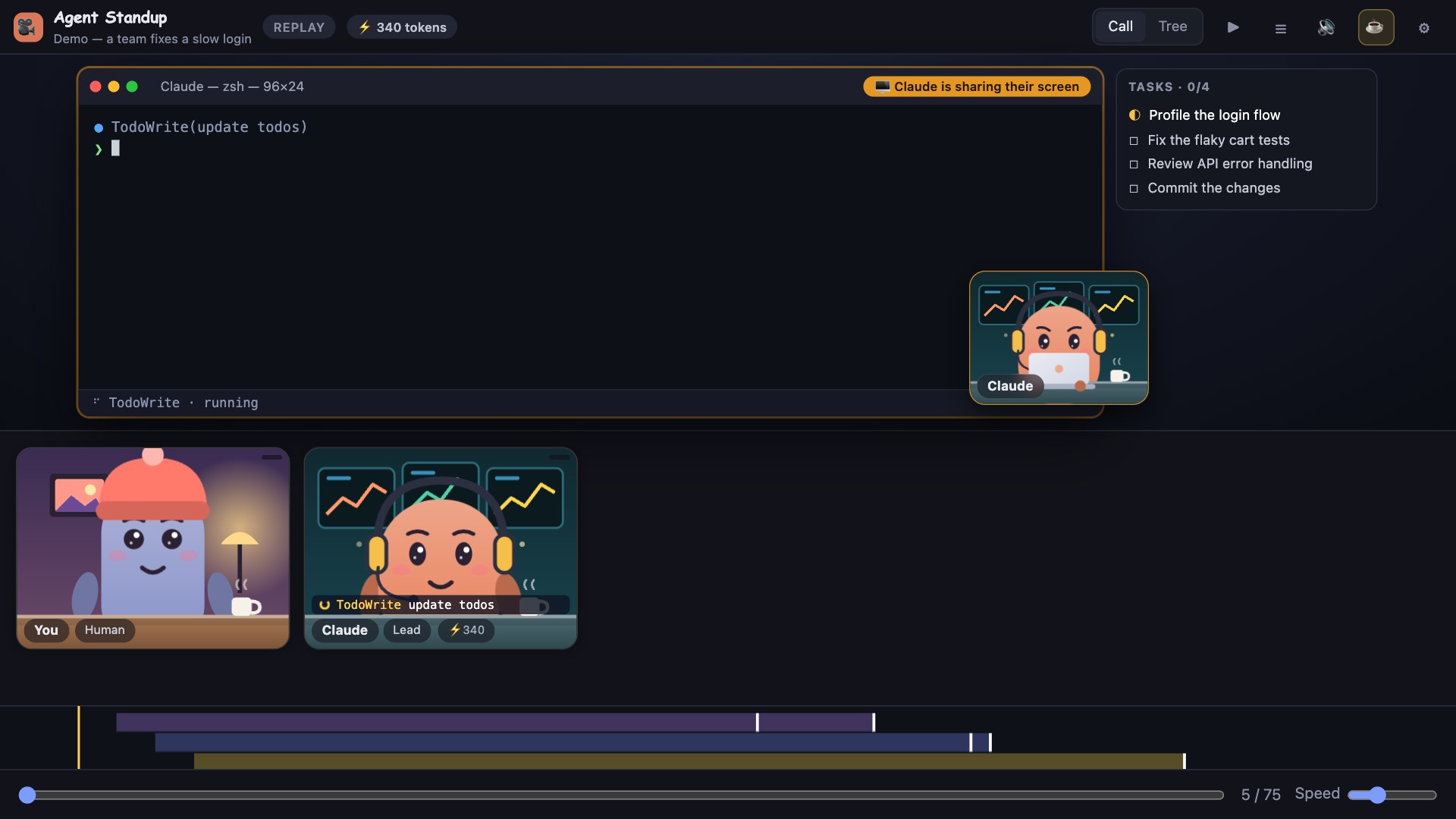
- Task list — if the agent keeps a todo list (TodoWrite, or Claude Code's and Cowork's task tools), a side panel shows it live (☐ pending, ◐ in progress, ☑ done); when the agent updates it, the list itself is shared, large, with a short flash on each task done.
- Claude Preview — the preview of a dev server (Claude desktop app) is a browser window too:
localhost:<port>, its screenshots, the shape of its last resize, and its last console lines under the page. - Web search and fetch — a search is a page of results (titles and sites); a fetched page shows its address, its HTTP status and size, and what the agent read from it.
- A plan to approve — the plan is shown as a document while the lead presents it.
- Your screenshots — the pictures you paste in your prompt are shared from your own camera for a few seconds.
- Codex pictures — the screenshots Codex takes, the images it views and the ones it generates.
- The presenter's camera lip-syncs when they speak; the subtitle bar shows what they say.
Click an agent — its prompt, tool counts and a Recent activity list (last 30 calls with status, duration, and expandable command + output).
Outputs are trimmed (about 1–2 KB each) to keep the call fast. Results of internal calls (sub-agent launches, messages) are not shown.
Screenshots
| Real commands, real output | The exact change | Who asked whom |
|---|---|---|
 |  |  |
| Task list of an agent | End-of-episode recap | In French |
|---|---|---|
 |  |  |
Personality, without noise
In a live call, an agent that has been at work for a while thinks to itself in a lighter bubble that is not said out loud: its own reasoning when the session keeps it, otherwise what it is on (the command it waits for, the files it goes between, its to-do item); about one in five is mumbled, low. In a live call, when the lead starts on its tools without a word after your order, it says what it is starting with ("Got it. Let me look at server.js."). Sub-agents answer when they get an order ("Running the tests, as usual.", "Grepping like there's no tomorrow."), say goodbye when they leave, and now and then have a little thought; a failing tool call makes the tile shake; confetti when the lead finishes a long job. Whoever receives a report sometimes says thanks ("Got it, thanks."), and an agent that has been thinking for a long time says so ("Hmm, let me think."). When the call has been silent for a while, someone fills the gap the way people do in video calls ("Can you hear me?", "You guys still here?", "Can everyone see my screen?"): after 45 seconds in a live call, about 10 seconds in a replay, at most three times per silence and further and further apart. It is all local (no API), absent from the transcript, and can be turned off in ⚙ → All settings → Little lines & animations.
Sub-agents also talk to each other, from what really happened: a new agent asks a question and the lead answers, a report gets a reaction that fits (all good, errors along the way, it took long) and sometimes a word from a third agent, an agent that fails three times in a row gets a “you okay?”, and every few minutes the lead calls a quick round. ⚙ → All settings → Chatter between agents: Quiet (only the real exchanges) / Normal (default) / Lively. When the lead finishes, it reads the part of its last message that the live reading had cut short, so you know what was done.
Glance without the panel (VS Code)
The status bar shows live counts for your workspace (needs you, working, your turn) and turns red when a session waits for your answer (a question or a permission is open); hover for the sessions (one stopped by Claude's usage limit says “⏳ usage limit · resets 7:20pm”, one that is logged out “⚠ logged out”), click to open the call on the most urgent one (agentStandup.statusBar). When nothing is at work or waiting for you and every session whose turn it is was stopped that way, the bar itself says so instead of “your turn” (⏳ usage limit · resets 7:20pm, logged out).
Context gauge, highlights, loop watch
The header shows how full the lead's context is (ctx 62%, orange then red, with a warning before auto-compaction); tiles and list rows show it from 50%. In Replay, the Highlights bar jumps to the first error, the longest wait, compactions and possible loops. A 🔁 badge marks an agent repeating the exact same call or failing repeatedly. The context window (200k or 1M) is inferred, because transcripts do not state it.
Works with your tools
| Where | How |
|---|---|
| VS Code | Install Agent Standup from the Extensions view (Marketplace). |
| Cursor, Windsurf, VSCodium… | Search Agent Standup in the Extensions panel of your editor: the same extension is on Open VSX. If the search finds nothing, download agent-standup-<version>.vsix from the latest release and use Extensions → … → Install from VSIX. |
| Any terminal, no editor | npx @double_geste/agent-standup@latest --open (Node 18+; the package is on npm). Without the npm registry: npx https://github.com/Atoll92/agent-standup/releases/latest/download/agent-standup-cli.tgz --open. |
| A small desktop app (macOS 13 or later) | Download Agent-Standup-<version>-mac-apple-silicon.zip (or -mac-intel.zip) from the release, unzip, move Agent Standup to Applications. The app is not signed with an Apple developer ID, so the first time: open it, close the warning, then System Settings → Privacy & Security → Open Anyway (on macOS 14 and earlier: right-click the app → Open → Open). Or run xattr -dr com.apple.quarantine "/Applications/Agent Standup.app". It has a window and an indicator in the menu bar, and notifies you when a session is waiting for your answer, with what it asks. Windows and Linux builds (-windows-x64.zip, -linux-x64.zip) are on the same release page but experimental and not tested by hand. |
| Claude Code status line | npm i -g @double_geste/agent-standup, then in ~/.claude/settings.json: { "statusLine": { "type": "command", "command": "agent-standup statusline" } } → shows ✋1 ⚙2 under your prompt. |
| tmux (not tested here) | set -g status-right '#(agent-standup status --here)' |
| Neovim (not tested here) | call vim.fn.system('agent-standup status --here') from a timer and show the result in your statusline plugin; agent-standup status --json gives machine-readable output: each session's state and, when they apply, since when it waits (since), how long it worked before (ran), and whether its turn ended on the usage limit (limit, with when it resets) or because it is logged out (auth); add --titles for each session's title, what it asks (ask, and about: what a waiting command is for) and why it stopped (gave: an error, or the agent saying it could not do it). |
| JetBrains IDEs (not native yet) | Settings → Tools → External Tools → +: program npx, arguments -y @double_geste/agent-standup@latest --open, working directory $ProjectFileDir$. |
Codex and Mistral Vibe sessions are read as well (see Codex sessions too and Mistral Vibe sessions too), and so are the Cowork sessions of the Claude desktop app (see Cowork sessions too). Other agent tools (Gemini CLI, OpenCode…) are researched in ROADMAP.md: their log formats are mostly undocumented, so no adapter is shipped for them yet.
Languages
Pick one in ⚙ → Language: English, Français, 繁體中文, 简体中文, Español, Deutsch, Dansk, Português (Brasil), 日本語, 한국어. The interface (menus, chips, tooltips, recap) is translated; VS Code's command titles, setting descriptions and status bar follow VS Code's own display language. English and French are written by hand; the other languages are AI-drafted and not yet reviewed by native speakers, so corrections are very welcome: each language is one small JSON file (public/locales/<code>.json), see public/locales/README.md to fix or add one (npm run i18n checks the files). The website and the landing page exist in the same ten languages, with the same caveat; their files are in website/locales/ and landing/locales/. The words the agents say stay in the language of your session, unless the call is held in French, Spanish or Brazilian Portuguese (see Translation); the little banter lines exist in these three languages and in English, the demo in English and French.
Your own characters
Your lead’s name. In ⚙ → All settings → Characters, Lead agent name is the default for every project. Name for this project overrides it for the project of the current live call or replay; clear it to use the default again (Margot if both fields are empty). The project folder is shown below the field. Sessions in the same folder share the name, including Claude Code, Codex and Mistral Vibe sessions. The editor’s agentStandup.leadName setting still wins over both fields. Forks follow the chosen name. Reset to defaults clears the global name and the current project’s override, leaving other projects’ names alone.
Your own agent names. A sub-agent you defined yourself (.claude/agents/code-reviewer.md) or named when it was launched keeps that name on its tile, in the transcript and in the voices: "Code Reviewer" rather than a first name drawn from the list. Two of the same type become "Code Reviewer" and "Code Reviewer 2". The agent types Claude Code ships (general-purpose, Explore, Plan…) still get a first name. ⚙ → All settings → Keep my agents’ own names turns it off.
Your sub-agents’ names. ⚙ → All settings → Characters → Sub-agent names takes a list of your own, separated by commas (Rex, Tom, Lulu). Sub-agents get them in the order they started, instead of the built-in first names and the nicknames Codex gives; once all are used, the list starts again as "Rex 2", "Tom 2"… The call renames everyone at once, and a reload, a replay or another window gives each agent the same name again (forks keep their number too). Start from the names in the call writes the names currently on screen into the field: change one there and that agent is renamed. The ✎ beside "Agents" in the agents list, and beside an agent’s name in its panel, open this field (for the lead, its name). Leave the field empty to get the built-in names back. Agents you named yourself keep their names while Keep my agents’ own names (just below the list) is on, with a number if another agent already has that name; turned off, they take names from the list too.
A cat pack ships with the app: ⚙ → Characters → Cat pack (11 cats by a contributor) puts them on the call at once, and Drawn characters goes back to the default. My folder uses your own images below (picked by itself the first time if your folder already has images).
Replace the drawn characters with your own pixel art. Drop PNG (or GIF, WebP, JPEG) files, 300 KB at most each, into ~/.agent-standup/characters (⚙ → Characters shows the folder, and in VS Code Open folder opens it; the agentStandup.charactersPath setting changes it):
lead.png(orclaude.png) is the lead,you.pngis you, any other image becomes a sub-agent (one per agent: two sub-agents only share an image once every image is taken);- an image named after a sub-agent is that agent's:
qa.pngis always the agent of.claude/agents/qa.md(or one launched with the nameqa), andqa-2.png,qa-f.png… are other looks of it for when two QAs are in the call. Case, spaces and underscores do not matter, and a plugin'smy-plugin:qaisqatoo. Other agents leave those pictures to them. The types Claude Code ships (general-purpose, Explore, Plan…) are not names here, soexplore.pngstays a picture for anyone; name-talk.pngnext toname.pngis an optional open-mouth frame that shows while the character speaks;- optional layers, as in the Halloween pack:
name-bg.png(its room),name-head.png(a head that nods while it speaks;name-talk.pngis then the head with its mouth open),name-hands.png(hands that type),name-desk.png/name-desk-dark.png(a laptop it pulls out now and then),name+hat-1.png,name+glasses-1.png… (extras it may wear, one of each kind or none); - 32×32 or 64×64 px, transparent background, facing front, feet at the bottom looks best. Pixel art keeps its hard pixels and large pictures are drawn smooth, on top of the usual scene and desk, and every status, hand and badge still works. Your characters sit at the desk without the laptop (it would cover the bottom of the sprite); ⚙ → All settings → Laptop in front of your own characters puts a darker one back while they work. Press Reload in ⚙ → Characters to see changes. Three example images to start from are in examples/characters (in the repository, not shipped with the app), and the cat pack is in examples/cats.
Agents list
On wide windows (900 px+), a fixed list sits left of the call: every agent with its role and one status line, most urgent first (needs you, stalled, working, waiting, done) and the lead pinned on top. It stays readable with dozens of agents, which a grid of tiles does not. Click a name to put that agent in the spotlight (kept for 25 s even when someone else speaks), double-click for details. Each line carries what the agent has used so far (⚡). An agent whose tile has left the stage keeps its line at the bottom, under “done”, with its count: click it for its details. Toggle it in ⚙ → All settings → Agents list (left). A status that does not fit takes two lines, and the whole text is in the tooltip.
Focus layout. ⚙ → All settings → Focus layout turns the characters into small cameras, with no big spotlight tile, and gives their room to the shared screen: the terminal, the page or the picture an agent works on. Off by default.
All your sessions (Sessions view)
The Sessions tab lists every session active in the last 12 hours, across all projects, in sections by state, what waits for you first: needs you, your turn, working, waiting on sub-agents, and idle, folded into one line until you open it (a card also says how many sub-agents are active). When sessions of two tools or more are listed, buttons at the top show one tool only (Claude Code, Codex, Mistral Vibe, Cowork). A session that waits for you says for how long, apart from how long it worked before (“worked 25 min · waiting on you for 12 min”), and one at work how long it has been at it. It refreshes every few seconds and reads only the end of each transcript, so thirty parallel sessions stay cheap. Click a card to follow that session in the call.
- The question on the card. A session that stopped on a question shows the question itself, so you can tell what it wants without opening it. One that waits for your go-ahead on a command shows the command and what it is for.
- Claude Code open, but saving no history. When Claude Code is open but saves no history because
CLAUDE_CODE_SKIP_PROMPT_HISTORYis set, the Sessions view and the empty call say so, with the folder it runs in and what to do. It is the only such case the app can see; for the others, see Troubleshooting. - Done. ✓ on a card whose turn is over, or that is idle, puts it away in a Done section at the bottom, closed until you open it. It comes back by itself when the session moves again; ↩ brings it back at once. Its tab leaves the row of tabs of the call too, unless the call is in that session. This is kept in a small file beside your settings, so every window agrees within a few seconds. The indicators (menu bar, status bar) still count the session.
- Its pull request. When Claude Code noted a pull request for a session, the card has a PR #n button that opens it on GitHub. Only pull requests on github.com are offered.
Several sessions at once. When a second session is active, a row of tabs appears under the header of the live call: it names the session the call is in and the others, each with its state. With a single session there is no row. The call is in the session you last touched: start a session or type in one, and the call goes there. The end of the row says why the call is in that session (where you last typed, where the work is, you went there, pinned by you…). Click a tab to pin the call there (📌): it stays while you go through the Claude Code tabs of your editor and while you type in it, until you ask something in another session, which takes the call there, or until you click that tab again. What the agents write does not move the call, so two sessions at work do not pull it back and forth. One case moves it without you: when the session you last typed in has finished and been quiet for a minute and a half while another one is still at work, the call goes to that one (a session you went to by a click is not left that way). When another session stops for you (a question, an edit that waits for your go-ahead, or its turn is over), a visitor leans in at the edge of the call, says which one, and takes you there on a click (⚙ → All settings → Display to turn it off). In VS Code the call also goes to the Claude Code tab you switch to, so a conversation and its call can sit side by side; a tab is matched by its title, so a conversation that has no title yet, the sidebar chat and a terminal do not move the call. Switching tab counts as going there by hand: the call stays with that conversation until you type somewhere else.
What needs you, in one line. In the live call, when another session waits for you, a red line under the header says which, what it asks and for how long, in the Call, Tree and Sessions views alike; “+2” counts the others (an agent of the call’s own session says it on the status line). Only a question or a permission menu that is really open counts, as Claude Code or Mistral Vibe reports it (in Cowork and Claude Code before 2.1.269, which do not report it, a question or a plan open in the transcript). Click it to answer: the call goes to that session, and the session opens where you can answer it: its Claude Code tab, in the VS Code, Cursor or Windsurf window that runs it (from the extension, the browser or the desktop app alike), or, on macOS, Terminal, iTerm2 or the Claude app it runs in, brought to the front (with several windows of an editor that does not have the Agent Standup extension, that editor comes to the front and you pick the tab). G goes there without opening it, one after the other. So does a click on the status line, the visitor, the question card or a notification.
Files made for you. When a turn ends, the files the session created for you show in one line under the call: those the lead names, else the documents (a report, a picture, a spreadsheet), not every source file it wrote. A document made by a command (an export, a report written by a script) shows too when the lead names it. Click one to see it in its folder; nothing is read and nothing is run. The whole list is behind “+N” (⚙ → All settings → Display to turn the line off).
At a glance
Every tile carries one status: working (with what it is doing), waiting on another agent (who), needs you (a permission or a question is open in the session, as Claude Code reports it; with a question mark, needs you?, when it is a guess: a file edit or write pending for 15 s+ in a session whose status Claude Code does not write; a guess stays on the tile, with no red line, sound or notification), with how long it has waited and, in the header, the question or the command it waits on, stalled (waiting on an agent that has been silent for 2 min+), or done. A summary sits in the header, and the browser tab's title and icon count every session that needs you, not only the one in the call. A session whose turn ended on Claude's usage limit shows ⏳ usage limit · resets 7:20pm (the time Claude Code gave), and one that is logged out shows ⚠ logged out: run /login, instead of gave up?, on the board and in the call. agent-standup status says the same, and the VS Code status bar says it in its tooltip. Recent Claude Code notes in ~/.claude/sessions when a menu waits for your answer (a permission, a question), and the app reads it: a Bash command waiting for your go-ahead shows “needs you” as soon as the menu opens, with the command (Bash(npm run build)), where the transcript alone makes it look like a command that runs. With ⚙ → All settings → A card with what the session asks you on (it is off by default), while such a menu is open in the session the call follows, the lead shows what it is, word for word, in a card beside the call until you answer it in Claude Code: each question with its number, its short label and “pick one” or “one or more”, each option on its own row with what it means under it, the command and what it is for, the file, or the plan to approve (a question Claude Code has not written down yet shows as "a menu is open" until it is). Where Claude Code does not note it, the signal is a heuristic: commands are not flagged because they can legitimately run for minutes (they get a ⏳ badge after 1 min instead), and edits that stay pending for 15 s+ are rare on real sessions, so it is mostly right.
Voices
With the real voices, each line is read with a voice of its own language (English, French, Spanish, Portuguese, and German, Danish, Japanese, Korean or Chinese once their voices are added), whatever language the interface is in. A line in a language with no natural voice here (German, Danish, Japanese, Korean and Chinese before their voices are added) is read by a system voice of that language when your computer has one, except in a call held in one of these five: those are natural voices or none, and until they are there the agents babble.
Two choices in ⚙ → Voice style (default: Natural voices):
-
Animal Crossing — every agent "talks" in gibberish, one blip per letter, with a sentence melody (up for questions, down for statements) and a register of its own.
-
Natural voices — Kokoro-82M, a small open speech model that runs on your machine. The real words, and the default: click Install in ⚙ (about 750 MB, one folder in your user cache, installed with npm; the model is fetched on first use, and one download covers every language). Until it is ready the agents babble, Animal Crossing style, and a line at the bottom of the call offers the install in one click (close it and it does not come back). It speaks English, French, Spanish and Brazilian Portuguese with eight voices each. The model has few voices outside English (one French, three Spanish, three Portuguese): the lead takes one as it is, and the other characters get one of them mixed with their English voice, so each agent sounds like itself in every language. These three languages need a phonemizer the install adds (eSpeak NG, 18 MB, GPL-3.0, fetched by npm like the rest and not shipped with the app); if you installed the voices before 1.32.0, ⚙ → Voice style offers to add them when the interface is in one of these languages, and until then their lines are read by your system voices.
-
German, Danish, Japanese and Korean — a second model, Supertonic 3 (Supertone; its weights are under the OpenRAIL-M licence, which forbids some uses), on the same runtime as Kokoro. With one of these four as the interface language, ⚙ offers it as Add the voices of this language, and so does the call once you have said yes to holding it in that language (about 400 MB; Install then fetches it with Kokoro, never before that yes; fetched from Hugging Face at a fixed revision, each file checked against its SHA-256 before it is kept). Eight of its voices, a woman and a man in turn, each character keeping its English name. Its worker starts only when a line in one of these languages comes, and holds about 470 MB of memory while the call is open. Measured with a speech recogniser (November 2026): Japanese and Korean lines came back word for word, German nearly so, Danish slightly less; file names inside Japanese or Korean are the weak spot.
-
Chinese (Simplified and Traditional; both Mandarin) — Kokoro's own Chinese model, Kokoro-82M-v1.1-zh (Apache-2.0), in the same worker as Kokoro. With Chinese as the interface language, Add the voices of this language fetches the model and eight of its hundred voices (about 365 MB, at a fixed revision, each file checked against its SHA-256) and adds three npm packages for its phonemes (pinyin-pro, jieba-wasm and opencc-js, all MIT). The phonemes are a JavaScript port of the model's own Python front end (misaki, Apache-2.0: word segmentation, pinyin, tone sandhi, Zhuyin), in
zh-g2p.js; on a test set of agent-like lines its syllables match the Python ones 99 % of the time. Traditional text is read once converted to Simplified (the sounds are the same).
Our tip: install the natural voices once you are set up. The agents then sound like real people, which is the nicest way to follow a call.
Up to 1.31.0 there were five styles, and the natural voices were called Very natural voices. The Cartoon voices (your system voices with an effect, the default then), the plain system voices and Simlish are gone. If you had Simlish you are now on Animal Crossing; if you had the cartoon or the plain system voices you are on the natural voices, which babble until they are installed.
Voice volume. ⚙ → Sound: a slider under Agent voices sets how loud the agents speak, apart from the music and the ambience.
Long lines are subtitled one sentence at a time, in step with the voice.
Handy extras
- Copy as Markdown in the recap: a ready-to-paste standup report (who did what, files, tokens, final report of each agent).
- Notify me when agents finish (⚙ → All settings): a soft chime, the tab title and, in VS Code, a notification once the team has worked for a while and gone quiet. When an agent asks you something (a question, a permission, a plan), a sharper double ding plays instead, so you can tell "needs you" from "done" by ear.
- Search the transcript, ambience volume, and a compact layout when the panel is narrow (side bar): under 480 px wide (when the agents list is not shown), one row per agent instead of tiles. In replay, speed presets (1×, 2×, 4×, 8×) an
Details
- Author
- @Atoll92
- GitHub Stars
- 385
- Sub-category
- Dashboards
- License
- MIT
- Surfaces
- terminal
- Added
- 1 months ago
- Last synced
- 1 day ago
- Events hooked
session.startui.render
Weekly Mods Digest
Top new Claude Code mods and install commands, once a week. No fluff, unsubscribe anytime.